Back to guide articles
Cookies, muffins and croissants with compound
Bakery · Technical application guide

Using Compound in Bakery Products

Where, why and how is it used?

In cakes, cookies, muffins, croissants, buns, wafers, biscuits and pastry products, compound is more than a flavouring ingredient. It is an important product-design tool for processability, appearance, texture, manufacturing efficiency and shelf-life performance.

In-dough applicationsBake-stable chipsFillingsCoatingsDecorationIndustrial processing
The basic approach

Why is compound used in bakery products?

Successful compound applications in bakery aim for more than chocolate flavour. A well-chosen product can directly affect baking performance, coating thickness, filling structure, cutting behaviour, shelf appearance and production-line efficiency.

A key advantage of compound is the ability to design its fat phase for the intended application. Some systems can therefore target faster crystallisation, greater shape stability, temper-free processing, different viscosity levels or more controlled melting at particular temperatures.

For bakery manufacturers, this means that one compound is not suitable for every application. A chip baked into a cookie and a thin biscuit coating, or a croissant filling and doughnut decoration, should not be expected to have identical physical properties.

The most important principle

Product selection should start with whether the product will be baked, used as a filling or coating, and the temperature at which it will be eaten, before asking whether it should be milk or dark.

Compound applications in cookies, muffins and croissants
Where is it used?

A wide range of bakery applications

Compound can serve as an inclusion mixed into a product or as a coating, filling or decoration applied after baking.

CakeIn batter / coating
CookieChips / chunks
MuffinBake-stable chips
CroissantFilling / decoration
BunFilling / drizzle
WaferFilling / coating
BiscuitCoating / sandwich filling
PastryGanache-like system / decoration
Functional applications

Four main application methods

Considering bakery compound applications in four main groups makes it easier to select the right product.

01

Mixed into dough or batter

The product is mixed into dough or batter as drops, chips or chunks. The aim is the desired degree of shape retention during baking, controlled melting and even distribution.

02

As a filling

It can be used as a pre-bake or post-bake filling system in croissants, buns, sandwich biscuits, wafers and cakes.

03

As a coating

Biscuits, wafers, cakes and bars can be fully or partially coated. Flow is a critical parameter influencing coating weight and mouthfeel.

04

As decoration

It can be used for decorative lines, drizzles, dipping, base coating, top-surface applications or moulded decorative pieces.

A product’s recipe should reflect how it will be used.

For compound mixed into dough, baking behaviour becomes important. Coatings prioritise viscosity, crystallisation and surface quality, while fillings emphasise cuttability, fat migration and texture stability throughout shelf life.

Baking performance

How do bake-stable compound chips work?

Bake-stable does not mean the product remains completely unchanged at high oven temperatures. The main aim is to retain its visual identity and some of its shape, rather than spread completely and disappear during baking.

Although the oven temperature is high, the actual thermal load on a chip depends on dough moisture, product core temperature, baking time, chip size and its position within the dough. The same chip can therefore behave differently in different recipes.

Shape retention depends not only on the fat system’s melting profile but also on the overall solids structure, sugar-to-fat balance, particle distribution, chip geometry and the way it hardens again after cooling.

Chip size

Small chips transfer heat more quickly; larger chips may show a different melting profile at their centre.

Baking time

Temperature alone is not enough. Longer baking increases the chip’s total thermal load.

Dough structure

Moisture, fat content and viscosity affect the chip’s heat exposure and distribution within the dough or batter.

Cooling

Controlled cooling after baking helps chips regain structure and preserve their surface appearance.

A product-by-product guide

Applications in cakes, cookies, muffins, croissants, buns, wafers and biscuits

Because processing conditions differ by product group, the focus should be on the compound best suited to the application rather than a single best compound.

01 · Cake / Brownie

Compound in cakes

Compound can be added to cake batter as chips or pieces, or used after baking as a surface coating or filling. In-batter applications require even distribution without sinking, visible pieces after baking and a texture that is not excessively hard when cut.

  • Batter viscosity and chip density should be balanced.
  • Applying a post-bake coating before the product has fully cooled can change coating behaviour.
  • In dense products such as brownies, chip size should also be assessed when a more pronounced particulate texture is desired.
02 · Cookie

Compound in cookies

Cookies are among the most visible applications for bake-stable chips. Since consumers expect to see chips on the surface, shape retention, colour and post-bake gloss matter. However, a chip that remains too hard may not suit the cookie’s bite texture.

  • Chip size should match the cookie diameter.
  • It is important to avoid breaking chips while mixing them into the dough.
  • Baking time and product core temperature should be evaluated alongside oven temperature.
03 · Muffin

Compound in muffins

Muffin batter is generally more fluid, so chips may be more likely to sink than in cookie dough. Chip size, batter specific gravity and the method of addition at the end of mixing should therefore be considered together.

  • Chips can be added at the final mixing stage with low mechanical stress.
  • If visible chips are wanted on top, some can be sprinkled onto the surface after depositing.
  • Interactions between the moist baked structure and the compound should be monitored throughout shelf life.
04 · Croissant / Bun

In filled pastries

Compound-based fillings can be applied before or after baking in croissants and buns. For pre-bake fillings, flow and leakage from the dough must be controlled. For post-bake fillings, pumpability, cuttability after cooling and mouthfeel at consumption temperature become important.

  • The filling’s fat phase should be compatible with the dough fats.
  • For pre-bake applications, the filling’s melting profile should be selected for the processing conditions.
  • Fat migration should be monitored over long shelf lives.
05 · Wafer

Wafer fillings and coatings

Wafers are sensitive to fat migration and moisture transfer because of their dry, crisp structure. When selecting a compound-based filling or coating, it is important to preserve wafer-sheet crispness, prevent excessive filling softening during storage and control the outer coating’s fracture behaviour.

  • Coating viscosity directly affects product weight.
  • Migration of filling fat into the wafer structure can alter crispness.
  • Packaging temperature after cooling is important for surface quality.
06 · Biscuit / Pastry

Coating and decoration

Biscuits can be fully coated, half-coated, base-coated or decorated with lines. Pastry applications include coatings for cakes, doughnuts and bars, decorative lines, moulded pieces and filling systems.

  • Thin coatings may require greater fluidity.
  • A different fat–viscosity balance is needed when a thick coating with a distinct snap is desired.
  • The tendency of the coating to crack on flexible products should be assessed separately.
Coating technology

Why is viscosity so important?

In compound coatings, viscosity means more than flow. It influences layer thickness, drainage from the edges, how quickly the coating develops structure in the tunnel, and how many products can be coated with one kilogram of coating.

A more fluid system can help create thin coatings and lower coating weights. A higher-viscosity system may be preferred when the target is a thicker layer, more pronounced snap or a stronger coating presence on the surface.

Viscosity is not determined by fat content alone. Particle size, the emulsifier system, temperature, mixing history and holding time can also change flow behaviour.

Keep coating temperature constant
Prevent contact with water and steam
Measure the target coating weight
Set the cooling tunnel for the product structure
Close-up of flowing compound coating
Filling systems

Flavour alone is not enough in filling design

In fillings for croissants, buns, sandwich biscuits, wafers and cakes, maintaining the initial texture throughout shelf life is as important as flavour.

The hardness and melting behaviour of compound-based fat fillings should be adjusted to consumption temperature. An overly hard filling can feel waxy when eaten cold; an overly soft filling can flow inside the package or distort the product during cutting.

Fat migration is the movement of fat between the filling and dough, biscuit or wafer phases. Over time, filling hardness can change, wafers can lose crispness and bloom-like surface problems can develop. Shelf-life studies should therefore assess physical stability as well as microbiological factors.

For water-containing fillings, water activity, moisture migration and emulsion stability become separate technical issues. A fat-based compound filling and a cream-containing filling should not be managed with the same processing logic.

What to monitor during storage

Filling hardness, oil separation, biscuit or wafer crispness, coating surface, changes in odour and flavour, cuttability and shape stability within the package.

A practical approach

Assessing the filling recipe at the beginning, middle and end of its target shelf life, rather than only on the production day, gives a more useful picture.

Selection matrix

How should the right compound be selected?

The table below shows general technical priorities by product category. Final selection should be validated against the recipe, production line and target-market conditions.

ApplicationPrimary propertySecond critical factorTypical targetWhat to consider
Cookie chipsShape retention during bakingBite textureVisible chips / controlled meltingBaking time and chip size
Muffin / cake chipsDistribution in batterControl of sinkingEven appearanceBatter viscosity and depositing time
Croissant / bun fillingFlow controlMouthfeel at consumption temperatureKeeping the filling inside the productPre-bake versus post-bake application
Biscuit coatingViscosityFast, even crystallisationControlled coating weightProduct temperature and tunnel settings
Wafer coatingThin, even filmStability against bloom and migrationPreserving crispnessCompatibility of filling fat and coating
Sandwich biscuit fillingHardness / cuttabilityFat migrationBalanced texture throughout shelf lifeBiscuit fat phase and storage temperature
Doughnut / cake glazeSurface adhesionResistance to crackingSmooth, attractive surfaceProduct flexibility and packaging conditions
Decorative lines / drizzleDosing behaviourRapid structure developmentSharp lines and a clean appearanceNozzle temperature and line speed

This table summarises general technical principles. Exact working temperatures and process parameters should follow the product specification.

Process control

Critical factors determining production quality

Working temperature

Excessive heating can harm flavour and oxidative stability. Too low a temperature can increase viscosity and cause coating or pumping problems.

Water control

Even small amounts of water contacting melted fat-based products can substantially change flow behaviour. Equipment should be kept dry.

Cooling tunnel

Excessively rapid or uneven cooling can increase surface stress and dullness; insufficient cooling can cause sticking and deformation during packaging.

Records and standardisation

Recording product temperature, line speed, viscosity, coating weight and tunnel parameters supports repeatable quality.

Tempering considerations

Many conventional compound systems can be processed without the cocoa-butter crystallisation control needed for chocolate. However, fat systems are not all the same. Follow the manufacturer’s instructions for specialised systems containing CBE or offering high cocoa-butter compatibility.

Shelf-life performance

The relationship between moisture, temperature, bloom and packaging

The appearance of a coating or filling in a bakery product is not determined solely on the production line. Storage temperature and humidity also affect its appearance weeks or months later.

Temperature fluctuations can encourage rearrangement of the fat phase and lead to dullness or fat-bloom-like problems. High humidity and condensation can increase the risk of surface sugar dissolving and recrystallising.

Packaging for coated biscuits, wafers and cakes therefore provides more than physical protection. Its barriers to moisture, oxygen, foreign odours and light are also part of product stability.

For products shipped to hot climates, formulation, packaging and the logistics chain should be considered together. A compound system with higher temperature tolerance cannot compensate indefinitely for unsuitable warehouse or container conditions.

FAT BLOOM

Fat-related surface changes

Fat migration, incompatible fat systems or temperature fluctuations can cause a greyish-white surface appearance.

SUGAR BLOOM

Moisture-related surface changes

Water condensing on the surface can dissolve sugar and leave a rough, recrystallised appearance after the water evaporates.

PACKAGING

Barrier performance

Moisture and oxygen permeability and protection against foreign odours become particularly important over long shelf lives.

LOGISTICS

Temperature fluctuations

During transit, consider repeated daily heating and cooling cycles as well as the average temperature.

Product formats

Which format offers advantages for each task?

DROPS / CHIPS

In-dough applications

This format allows portioning and even distribution in cookies, muffins and cakes. If bake stability is needed, the recipe should be designed accordingly.

FLAKES / BUTTONS

Rapid melting

A larger surface area can ease melting and dosing. This format can be practical for preparing coatings and fillings.

BLOCK / SLAB

Industrial use

This can be an economically and logistically suitable format for products used in melting tanks or coating lines.

SPECIAL PIECES

Visual differentiation

Chunks, mini chips, large chips and different colours or flavours can change a product’s visual identity and consumer experience.

Troubleshooting

Common problems and possible approaches

These points provide a starting point for diagnosis. The actual cause should be identified by examining the recipe and production-line conditions together.

Problem
Possible cause
Approach to check
Chips disappear completely during baking
The chip’s melting or solids profile does not suit the application; the chip is too small or the thermal load too high.
Assess bake-stable product selection, chip size, baking time and product core temperature together.
Muffin chips sink to the bottom
The batter is too fluid; chip density and size are incompatible with the batter structure; holding time is long.
Check batter rheology, chip size, addition sequence and holding time before depositing.
The coating is too thick
High viscosity or low working temperature; an imbalance in excess coating carryover and return flow.
Measure viscosity at the temperature specified for the product; adjust line speed and the coating curtain.
The coating looks dull
Incorrect cooling, moisture, product surface temperature or uneven crystallisation.
Record tunnel-zone settings, ambient dew point, coating temperature and base-product temperature.
The coating cracks
The coating is too hard; the base product is flexible; coating thickness or the fat matrix does not suit the application.
Consider a more flexible coating system or a more appropriate thickness; examine moisture changes during shelf life.
The filling hardens or softens over time
Fat migration, storage temperature or incompatibility between fat phases.
Evaluate filling, dough and coating together using accelerated and real-time shelf-life tests.
A short checklist for manufacturers

Ten questions for a new bakery project

1Will the compound be baked or applied after baking?
2Will it be used as chips, filling, coating or decoration?
3What is the target consumption temperature?
4What snap and mouth-melting profile is desired?
5What is the target coating weight or filling ratio?
6What melting, pumping and cooling conditions are available on the line?
7What climate and logistics conditions will the product face?
8What is the target shelf life?
9Which other fat phases will contact the product?
10Which quality-control measurements will be monitored regularly?
Frequently asked questions

Common questions about compound in bakery products

Can every compound be used in the oven?
No. A compound designed for coating may not retain a chip shape in the oven. Products designed for bake stability should be selected for baking applications and tested in the actual product recipe.
Why do bake-stable chips not melt?
Rather than literally not melting, they retain some shape and particle integrity under thermal load. The fat system, solids structure, chip size, dough moisture and baking time all contribute.
Does compound coating require tempering?
Many conventional compound systems do not require the tempering process used for chocolate. However, processing can vary with the fat system and cocoa-butter compatibility; the product specification should be followed.
What matters for a thin biscuit coating?
Flow, working temperature, particle distribution, line speed and cooling conditions all matter. Greater fluidity generally helps form a thinner film, but the desired snap and shelf-life performance should also be considered.
Why do compound chips sink in muffins?
Low batter viscosity, chip size and density, and holding time before depositing are important factors. The addition sequence and mechanical stress at the end of mixing can also affect the result.
Why does fat migration matter in wafer fillings?
Movement of filling fat into the wafer or outer coating can change texture over time, causing loss of crispness, softening or surface changes. The formulations should therefore be tested together throughout shelf life.
Can a coating be made more resistant to hot weather?
The fat system can be designed to target higher temperature stability. Storage, packaging and transport conditions must still be controlled; no formulation provides unlimited heat resistance.
Which compound has the highest quality?
There is no single highest-quality product. Quality should be judged by suitability for the intended application. A product that works excellently in cookies may naturally perform differently in a thin biscuit coating.
Conclusion

Selecting the right compound for bakery products means managing baking behaviour, viscosity, texture, cooling, shelf stability and logistics conditions alongside flavour.

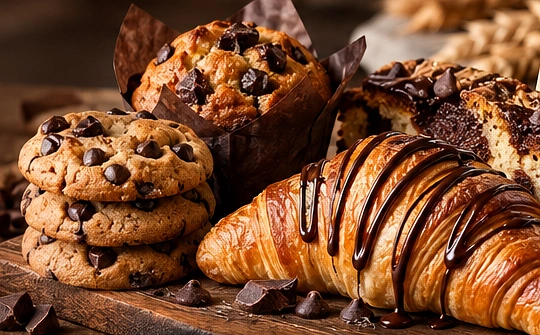
Compound can play many roles: visible chips in cookies, inclusions in muffins, fillings in croissants, thin coatings on biscuits, fillings and outer coatings for wafers, cake decoration or a mouldable ingredient in pastry.

Successful applications therefore depend more on matching the right fat system, physical properties and process than on the product name. When selected to suit production conditions, compound becomes a powerful technical tool for standardisation, efficiency, appearance and the consumer experience.